
According to a recent report by Bloomberg, Apple is entering into preliminary negotiations with Google to fully recreate Siri’s voice assistant using its Gemini artificial intelligence model. If that were to be achieved, it would be one of the most subversive “competitions” in the history of the scientific and technological industry, with two giants who had long dominated mobile ecology and could form a new coalition of rights in the AI generation.
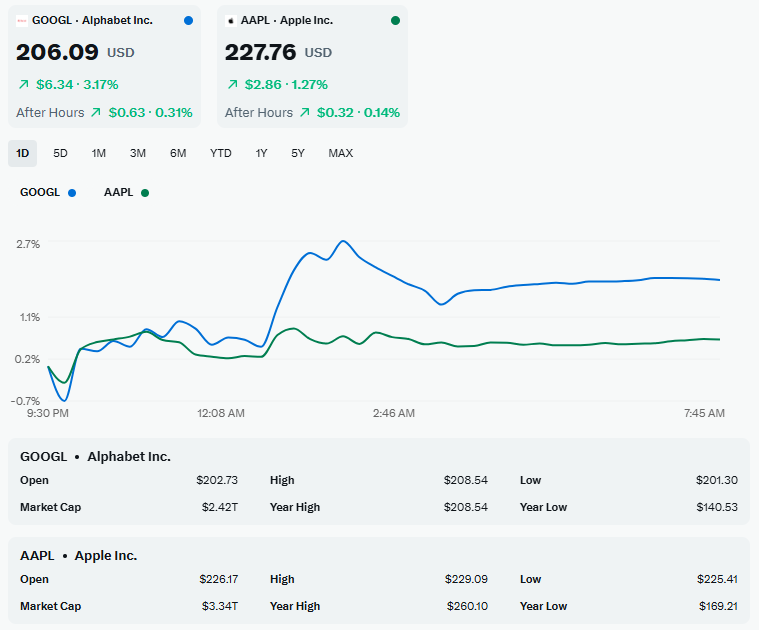
According to the source, Apple recently approached Google to develop a customized AI model for its new version of Siri next year. The negotiations are still at an early stage, and apples are expected to take weeks to decide whether to choose between a self-study programme or external cooperation. As a result of this information, the capital market has shown a strong optimism about the potential for marriage, with a 3.7 per cent increase in the price plate and a 1.6 per cent increase in apples and apples.
This cooperation is taking place in the context of the successive failures of apples in the generation of the AI arms race, where apples are currently facing a difficult internal and external problem. Siri ‘ s ability to handle complex multi-step tasks has long been less than Google Assistant and Alexa. The major upgrade of Siri, originally scheduled for the spring of 2024, was delayed by one year because of the construction barriers, and involved in litigation because of the false promotion of the new version of Siri and the failure to provide over-exploitation. In addition, there is production pressure from an outside vendor – Samsung and Androids have integrated the AI function.
Apple had previously contacted businesses such as Anthropic and OpenAI to assess the possibility of Claude or ChatGPT driving Siri. Google Gemini, however, is the most competitive option because of its multimodular capabilities and mobile-end deployment experience.
For apples, this cooperation means a triple strategic value. The time-for-space exchange, the quick completion of the AI window by directly borrowing Google mature technology; the achievement of synergies at the AI level while maintaining the iOS-Android competition pattern with the ecological complementarities of iOS and Android in the mobile market; and the ability to spread risks and avoid the long-term technical deficiencies that may result from full self-study.
For Google, it was possible to plant its AI technology deep into 2 billion apple-active devices in this cooperation valley, which would generate billions of dollars of authorized revenue each year and reinforce the de facto standard position in the mobile AI area.
However, apples and Google cooperation continue to face many obstacles. For a long time, apples and Google have been the “focus of attention” of antimonopoly reviews, and regulators may question the deep binding of two firms with a combined market value of over $4 trillion. At the technical level, the suitability of Gemini and Apple for self-study chips and nerve engines requires complex engineering optimization. The two giants, troubled by privacy issues, will focus on how to balance cloud-based AI treatment with end-side privacy commitments.
Finalization of cooperation would mark the beginning of a new phase of AI competition. The boundary between traditional equipment manufacturers and AI algorithms has become increasingly blurred, the strategic choice of “self-study VS cooperation” has become a central proposition for technology companies, and mobile ecological competition has risen from the operational system level to the AI capacity level.
Apple CEO Cook once stated that “a new path will be opened in the area of AI”, and this negotiation could be a turning point on that path. As WWDC 2025 approaches, the industry is closely following this strategic game that may reshape the intelligent assistant pattern.